
EBOLA VIRUS DISEASE (EVD) FACT SHEET
-
Overview
Ebola Virus Disease (EVD) — now formally referred to in WHO/ICD-11 nomenclature as Ebola disease with sub-classification by causative virus — is a severe, often fatal viral haemorrhagic fever in humans and other primates. It is caused by viruses of the genus Orthoebolavirus (formerly Ebolavirus), within the family Filoviridae. The disease was first recognised in 1976 in two near-simultaneous outbreaks in Nzara (South Sudan) and Yambuku (near the Ebola River, in what is now the DRC).
2. Current Regional Outbreak (May 2026)
2.1 Causative strain
The current outbreak is caused by Bundibugyo virus (BDBV), species Orthoebolavirus bundibugyoense. This is a rare ebolavirus species first identified in Bundibugyo District, western Uganda, in 2007. Historical case-fatality rates for Bundibugyo virus disease (BVD) have ranged from 30% to 50%. Crucially, there are no licensed vaccines or specific therapeutics against Bundibugyo virus — the Ervebo vaccine, Inmazeb and Ebanga (all approved against Zaire ebolavirus) are not effective against this strain.
2.2 Outbreak in the Democratic Republic of the Congo
- Date declared: 15 May 2026, by the DRC Ministry of Public Health, Hygiene and Social Welfare. This is the 17th Ebola disease outbreak in the DRC since 1976.
- Origin: Mongbwalu Health Zone, Ituri Province (a high-traffic artisanal mining area), with subsequent migration of cases to Rwampara and Bunia health zones in search of care.
- Laboratory confirmation: On 15 May 2026, the Institut National de Recherche Biomédicale (INRB), Kinshasa, confirmed Bundibugyo virus in 8 of 13 blood samples collected on 14 May from Rwampara Health Zone.
- Case count (as of 16 May 2026): 8 laboratory-confirmed cases, 246 suspected cases, and 80 suspected deaths reported across at least three health zones (Bunia, Mongbwalu, Rwampara) in Ituri Province. 24 patients in isolation.
- Demographics: Most suspected cases are aged 20–39 years, and women account for more than 60% of infections — consistent with significant household and caregiving transmission. Health-worker deaths have been reported among the early cases.
2.3 Outbreak in Uganda
- Cases: 2 laboratory-confirmed imported cases reported on 15 and 16 May 2026 in Kampala, including 1 death. Both index cases were travellers from the DRC and had no apparent epidemiological link to each other, indicating at least two separate introductions of the virus into Uganda.
- Local transmission: As of the WHO update on 17 May 2026, there is no indication of ongoing local transmission within Uganda. Contact tracing is underway.
- Significance: This is the first reported outbreak of Bundibugyo virus disease in Uganda since the 2007 index identification, and the first BVD outbreak in DRC since 17 August 2012 (Province Orientale).
2.4 WHO PHEIC determination
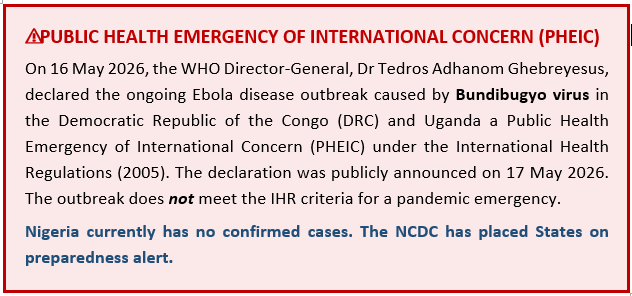
In line with Article 12 of the International Health Regulations (2005), the WHO Director-General, after consultation with the affected States Parties (DRC and Uganda), determined on 16 May 2026 that the event constitutes a Public Health Emergency of International Concern. The determination was based on:
- Confirmed international spread to Uganda from DRC, with two unlinked introductions into Kampala.
- A high test-positivity rate among initial samples (8 of 13), indicating that detected cases likely represent only a fraction of the true outbreak.
- Clusters of community deaths and increasing syndromic reporting of suspected cases across multiple health zones in Ituri.
- Operational challenges: ongoing insecurity and humanitarian crisis in eastern DRC, high population mobility, urban/semi-urban nature of affected zones, dense informal healthcare networks, and proximity to Uganda and South Sudan (Bunia is less than 500 km from the Ugandan border).
- The absence of approved Bundibugyo-specific vaccines or therapeutics, increasing dependence on traditional outbreak control measures.
WHO has issued temporary recommendations emphasising enhanced surveillance and laboratory capacity in affected and neighbouring provinces, infection prevention and control, safe and dignified burials, risk communication and community engagement, and cross-border coordination. WHO does not recommend any travel or trade restrictions on the DRC or Uganda.
3. Causative Agents and Reservoir
EVD is caused by viruses of the genus Orthoebolavirus. Six species are currently recognised, four of which are known to cause disease in humans. The natural reservoir is not definitively established, but African fruit bats (family Pteropodidae) are strongly implicated. Spillover into humans is typically initiated by contact with infected wildlife (bats, non-human primates, forest antelope), followed by sustained human-to-human transmission.
3.1 Ebolavirus species at a glance
| Species | Abbrev. | Typical CFR | First identified | Human disease |
| Zaire ebolavirus | EBOV | Up to ~90% | 1976, DRC (Yambuku) | Yes — most outbreaks |
| Sudan ebolavirus | SUDV | 41–70% | 1976, Sudan (Nzara) | Yes |
| Bundibugyo ebolavirus | BDBV | 30–50% | 2007, Uganda (Bundibugyo) | Yes — current outbreak |
| Taï Forest ebolavirus | TAFV | Single case (recovered) | 1994, Côte d’Ivoire | Yes — 1 known case |
| Reston ebolavirus | RESTV | Not pathogenic in humans | 1989, Philippines (in NHPs) | No clinical disease |
| Bombali ebolavirus | BOMV | No human disease reported | 2018, Sierra Leone (in bats) | None reported |
4. Mode of Transmission
EVD is transmitted through direct contact (broken skin or mucous membranes) with:
- Blood and body fluids (sweat, saliva, vomit, urine, faeces, semen, breast milk) of a symptomatic, recovering, or deceased person infected with EVD.
- Objects (needles, syringes, medical equipment, clothing, bedding) contaminated with body fluids from an infected person.
- Infected animals — bats, non-human primates, forest antelope — through handling, butchering, or consumption of bushmeat.
- Corpses of persons who died from EVD, particularly during traditional burial rites involving washing or touching the body.
- Healthcare settings, when standard precautions and infection prevention and control (IPC) measures are inadequate.
Note: EVD is not airborne. Persons are not infectious during the incubation period — transmission requires the onset of symptoms. Sexual transmission via semen has been documented for months after recovery from Zaire ebolavirus infection.
5. Incubation Period
- Range: 2 to 21 days
- Typical: 5–12 days
- Individuals are not infectious until symptoms begin.
6. Case Definitions (per WHO / NCDC)
A. Suspected case
Any person — alive or deceased — presenting with acute fever AND one or more of:
- Sore throat or difficulty swallowing
- Headache, muscle or joint pain
- Diarrhoea, vomiting
- Abdominal pain
- Hiccups
- Unexplained bleeding (gums, gastrointestinal, urinary, vaginal, or from injection sites)
…AND with an epidemiological link (travel to an affected area within 21 days, contact with a confirmed/probable case, contact with a dead/sick wild animal, or healthcare exposure).
B. Probable case
A deceased or living person with clinical symptoms consistent with EVD AND an epidemiological link to a confirmed or probable case, WITHOUT laboratory confirmation.
C. Confirmed case
Any suspected or probable case with laboratory confirmation via:
- Reverse transcription polymerase chain reaction (RT-PCR) — gold standard
- Antigen detection (e.g., ELISA)
- Virus isolation in BSL-4 facilities (for research / reference confirmation)
Designated testing facilities in Nigeria: Lagos State Biobank [Biosafety Level 3 Lab], Central for Humans and Zoonotic Virology Laboratory (CHAZVY), College of Medicine, University of Lagos and the National Reference Laboratory (NRL) Gaduwa, Abuja, and other NCDC-approved laboratories within the Nigerian VHF testing network.
7. Clinical Presentation
Onset is usually abrupt. Clinical course typically progresses in two phases:
- Early (“dry”) phase — days 1–3: Fever, fatigue, headache, sore throat, myalgia, arthralgia.
- Wet phase — days 3–10: Vomiting, watery diarrhoea (often profuse), abdominal pain, rash, hiccups, conjunctival injection. Severe dehydration and electrolyte disturbance are leading causes of death.
- Late / severe phase: Haemorrhagic manifestations in a subset of patients (typically <50%): petechiae, ecchymoses, mucosal bleeding, GI haemorrhage, multi-organ failure, shock.
8. Case Management
Important: Approved Ebola therapeutics are strain-specific. Monoclonal antibody therapies licensed for Zaire ebolavirus are not effective against Sudan virus or Bundibugyo virus, which are the strains of concern in the current outbreak.
A. Supportive care (mainstay for all strains)
- Aggressive oral and intravenous rehydration; correction of electrolyte and acid–base disturbances.
- Oxygen support and ventilatory care as required.
- Antipyretics and analgesia; antiemetics for vomiting.
- Treatment of co-infections (malaria, typhoid, bacterial sepsis) which are common and often co-exist.
- Nutritional support.
- Blood-product support (fresh frozen plasma, platelets) in haemorrhagic disease where available.
Early initiation of optimised supportive care substantially reduces case-fatality rates.
B. Strain-specific therapeutics and vaccines
| Strain | Licensed vaccine(s) | Licensed therapeutic(s) | Status in Nigeria |
| Zaire (EBOV) | Ervebo (rVSV-ZEBOV)
Zabdeno/Mvabea (2-dose) |
Inmazeb (atoltivimab / maftivimab / odesivimab)
Ebanga (ansuvimab) |
Not available in routine stocks. |
| Sudan (SUDV) | None licensed. Candidates in trials: cAd3-EBO S (Sabin); ChAdOx1 biEBOV (Oxford); rVSV-SUDV. | None licensed. Supportive care only; remdesivir and MBP134 evaluated experimentally. | Not available. |
| Bundibugyo (BDBV) | None. | None. Supportive care only. | Not available. |
9. Vaccination
- Ervebo (rVSV-ZEBOV-GP) — WHO-prequalified live-attenuated single-dose vaccine effective against Zaire ebolavirus only. Used via ring-vaccination strategy in outbreak settings.
- Zabdeno/Mvabea (Ad26.ZEBOV / MVA-BN-Filo) — two-dose prophylactic regimen, Zaire ebolavirus.
- Sudan virus and Bundibugyo virus: No licensed vaccine exists. Investigational SUDV vaccines (cAd3-EBO S; ChAdOx1 biEBOV) have entered ring-vaccination trials in Uganda during recent outbreaks.
None of these vaccines are currently part of Nigeria’s routine immunisation schedule. Deployment in an outbreak would be coordinated through the WHO Strategic Advisory Group of Experts (SAGE), the WHO ICG mechanism for Ebola vaccines, the Federal Ministry of Health and Social Welfare, NCDC, and partners.
10. Lagos State Preparedness and Response Actions
To reassure the public and healthcare stakeholders, the Lagos State Government has proactively activated the following preparedness and response measures:
- Emergency Coordination: The State Public Health Emergency Operations Centre (PHEOC) has been placed on Alert Mode to actively monitor the situation and coordinate state-wide preparedness.
- Enhanced Surveillance: Active disease surveillance is ongoing across all LGAs. The Ministry is actively sensitizing disease surveillance officers and healthcare workers in both public facilities and private facilities to maintain a high index of suspicion for EVD and other viral haemorrhagic fevers.
- Laboratory Readiness: Lagos State maintains robust diagnostic capacity. Designated laboratories within the state are fully equipped to conduct immediate Polymerase Chain Reaction (PCR) testing for Ebola.
- Case Management & Isolation: The State’s dedicated infectious disease Isolation Centre (Mainland Hospital, Yaba) is fully operational and on standby to safely isolate and treat any suspected cases.
- Healthcare Worker Training: Routine case management and Infection Prevention and Control (IPC) training for frontline workers have been modified to include updated, specific protocols for the current Ebola strain.
- Logistics & Supplies: The State is actively auditing and positioning adequate stockpiles of Personal Protective Equipment (PPE) to ensure the safety of all healthcare and frontline workers.
- Public Sensitization (RCCE): Information, Education, and Communication (IEC) materials are currently being deployed to educate communities on risk factors and prevention without causing panic.
11. Infection Prevention and Control (IPC)
Key measures
- PPE: Double gloves, fluid-resistant gown or coverall, head cover, N95 / FFP2 respirator or equivalent (where aerosol-generating procedures are performed), goggles or face shield, impermeable apron, and rubber boots. Strict donning and doffing under a trained observer.
- Hand hygiene: Soap and water, or alcohol-based hand rub, at every WHO “5 moments”.
- Disinfection: 5% chlorine for surfaces and waste; 0.05% chlorine for skin and hands during patient care; hospital-grade disinfectants for equipment.
- Dedicated thermometers, stethoscopes, and BP cuffs per patient; decontaminate between uses.
- Waterproof bed coverings; safe disposal of single-use items; safe linen management.
- Triage and isolation: screen at entry for fever and epidemiological exposure; isolate suspected cases immediately in a designated area with separate entry and waste streams.
- Safe and dignified burial teams must be activated for all suspected EVD deaths.
12. Reporting and Referral Protocol
In case of a suspected case, healthcare workers must immediately:
- Isolate the patient in a designated area while awaiting transport.
- Notify the Lagos State Ministry of Health and the NCDC.
- Report through LGA Disease Surveillance and Notification Officer via the IDSR and SORMAS platforms.
- Avoid sample collection unless trained and equipped; coordinate with the State Epidemiologist and designated laboratory.
Key Contact numbers
- Lagos State Ministry of Health: 767 / 112
- Directorate of Epidemiology, Biosecurity and Global Health: 0802 396 2151
- Additional line: 0802 316 9485
Directorate of Epidemiology, Biosecurity and Global Health, Lagos State Ministry of Health
Website: www.lagosministryofhealth.org,
Social Media Handles: X (Twitter) – @LSMOH, Instagram – @lagoshealth, Facebook – @LagosStateMinistryofHealth, YouTube – @LagosStateMinistryofHealth
13. Key References and Sources
This factsheet is informed by the following authoritative sources (accessed 17 May 2026):
[1] World Health Organization (17 May 2026). Statement: Epidemic of Ebola disease caused by Bundibugyo virus in the Democratic Republic of the Congo and Uganda determined a Public Health Emergency of International Concern. who.int/news/item/17-05-2026-epidemic-of-ebola-disease-in-the-democratic-republic-of-the-congo-and-uganda-determined-a-public-health-emergency-of-international-concern
[2] World Health Organization (16 May 2026). Disease Outbreak News (DON) 2026-DON602: Ebola disease caused by Bundibugyo virus — Democratic Republic of the Congo and Uganda. who.int/emergencies/disease-outbreak-news/item/2026-DON602
[3] WHO Regional Office for Africa (15 May 2026). DRC confirms new Ebola outbreak; WHO scales up support — Ituri Province. afro.who.int
[4] Nigeria Centre for Disease Control and Prevention (17 May 2026). Public health advisory: Ebola Virus Disease outbreak in the Democratic Republic of the Congo and Uganda. NCDC/HQ/ABJ/04/V.IV/165.
[5] Nigeria Centre for Disease Control and Prevention (17 May 2026). Letter to State Commissioners of Health: Strengthening state preparedness following declaration of EVD outbreak as PHEIC. Office of the Director-General.
[6] World Health Organization (1 February 2025). Disease Outbreak News 2025-DON555: Sudan virus disease — Uganda.
[7] World Health Organization (February 2025). Disease Outbreak News 2025-DON556: Sudan virus disease — Uganda (update).
[8] Centers for Disease Control and Prevention (6 February 2025). HAN Advisory 00521: Ebola Outbreak Caused by Sudan virus in Uganda. cdc.gov/han/php/notices/han00521.html
[9] Centers for Disease Control and Prevention. Ebola — Outbreak History (updated 2026). cdc.gov/ebola/outbreaks
[10] Aceng JR, Wanyenze RK, et al. (2024). Ebola disease outbreak caused by the Sudan virus in Uganda, 2022: a descriptive epidemiological study. The Lancet Global Health.
[11] Nyakarahuka L, Schuh A, et al. (2023). Molecular characterization of the 2022 Sudan virus disease outbreak in Uganda. PMC10617429.
[12] Towner JS, Sealy TK, Khristova ML, et al. (2008). Newly Discovered Ebola Virus Associated with Hemorrhagic Fever Outbreak in Uganda — identification of Bundibugyo ebolavirus. PLoS Pathogens.
[13] International Health Regulations (2005), 3rd edition. World Health Organization, Geneva.